
Stump Grinding in Oakland County: Cost and What to Expect
Updated September 7, 2026 · Written by Rob Burgund, ISA Certified Arborist MI-4857A
- ISA Certified Arborist MI-4857A
- Working in Oakland County since 2013
- Licensed and insured
- 5.0 stars from 16 Google reviews

Written by Rob Burgund
ISA Certified Arborist · MI-4857A
Rob owns Tree Pros, LLC in Bloomfield Township and is the arborist who quotes and works every job. He has been doing tree work in Oakland County since 2013. More about Rob and Tree Pros, or verify the certification in ISA’s public directory.
Why the stump is worth dealing with
Leave the stump and you have kept a piece of the problem. It is a trip hazard and a mowing obstacle from day one.
As it decays it becomes prime real estate for carpenter ants, and a host for the decay fungi that can move on to healthy trees nearby.
A few species keep fighting after they are cut. Tree of heaven, black locust, poplar and aspen, and sassafras will send suckers up through the lawn for years, sometimes well away from where the tree stood. Most species, silver maple included, only sprout from the stump and root collar, the flared base where the trunk meets the roots. Grinding the stump out ends it.
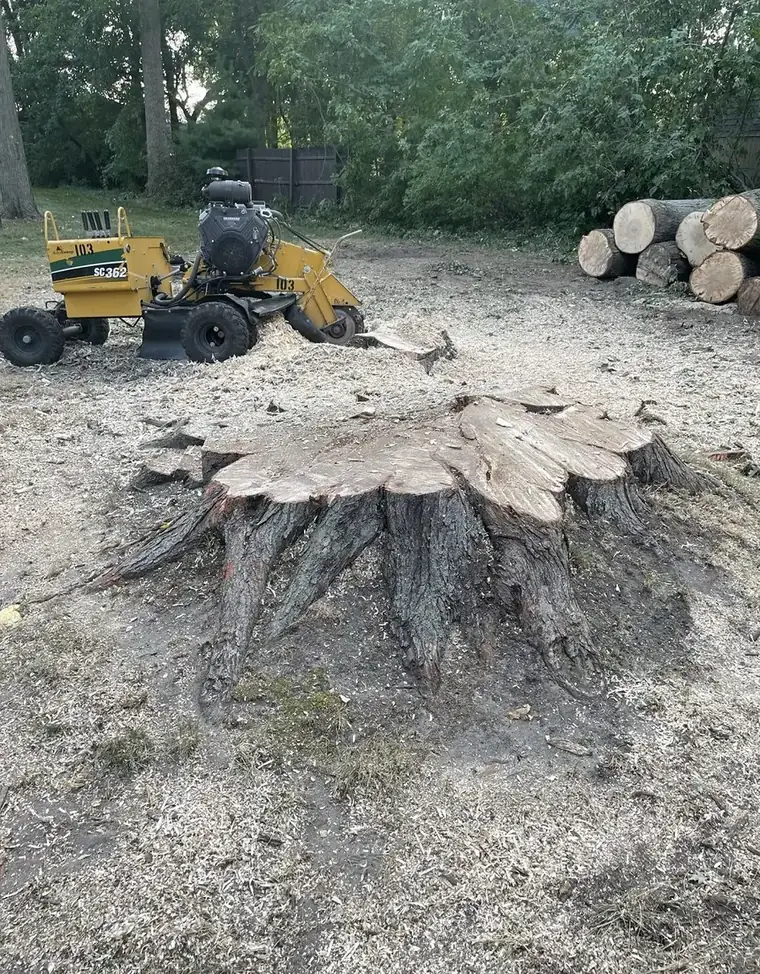
Grinding or full excavation?
| Method | Typical cost | What you are left with |
|---|---|---|
| Stump grinding | $125 per foot of diameter | Ground 6 to 12 inches below grade, chips backfilled or hauled. Ready to seed. |
| Full root excavation | $400 to $1,000+ | The entire root plate removed. What you need before hardscaping or replanting in the exact same spot. |
Grinding is the right answer for most yards. Full excavation earns its cost when a patio, a fence post, or a replacement tree is going exactly where the old one stood.
What sets the price
- Diameter. $125 per foot of stump width at its widest point. A stump two feet across is twice the job of one a foot across.
- Access. The grinder has to get there. Narrow gates, slopes, and soft ground all add time.
- The flare. A stump that spreads wide at the base is a bigger job than its trunk diameter suggests.
- What is buried nearby. Irrigation lines, invisible dog fencing, and utilities all need locating before the teeth go in.
- The chips. Grinding throws off a surprising volume of them. Backfilling the hole costs nothing. Hauling them away costs more.
If we are already on site removing the tree, grinding the stump then and there skips a second trip entirely. It is almost always cheaper than calling anyone back later, us included. Removal pricing is on our tree removal page, and the full picture of what moves a price is in the Oakland County cost guide. If you are still deciding whether to grind at all, read why the stump is worth grinding after a removal.
What happens on the day
We locate anything buried near the stump first, then set the grinder and work the stump down in passes until we are 6 to 12 inches below grade. The chips either go back in the hole, get piled where you want mulch, or go on the truck. We rake out and leave a spot you can seed the same week.
Marie, whose condo community had several trees taken down and stumps ground, put it this way in her review: they clean up everything.

What customers say
5.0 stars from 16 Google reviews as of October 2026. Every review below is copied word for word from our Google listing, where you can read all of them.
- “Tree Pro did an excellent job in cutting down trees and grinding stumps in our condo community. They clean up everything. I would recommend them and our community will be using them for additional work needed.”
Marie · May 2026 · Google review - “They did a great job. Quoted right away. Very reasonable pricing. Came right out and took care of the job. Cleaned up after. Great experience.”
Alex M. · August 2026 · Google review - “Tree Pros did a great job for me and my for my brother. Dropped everything on the ground like pros should and cleaned up well. Good pricing too. I’ll recommend them to anyone.”
Brett R. · May 2026 · Google review
Stump grinding questions we hear every week
How much does stump grinding cost in Oakland County?
$125 per foot of stump diameter, measured at the widest point of the stump, not the trunk higher up. A stump 18 inches across is about $190; a stump three feet across is $375. Access, a wide root flare, and hauling the chips away can add to that. Booking the grind with the tree removal is the reliable way to keep the number down, because the equipment is already on site. Full excavation of the root plate, which you only need if you are building or replanting in the exact same spot, runs $400 to $1,000 or more. Stump grinding is one of the few jobs we can price from a photo, so send one with something in it for scale.
How deep do you grind?
Six to twelve inches below grade, which is enough to lay sod or seed right over the spot, and deeper on request if you are replanting or building. Worth knowing: no industry standard actually requires a depth, and a routine grind from many outfits is only 4 to 6 inches. That is the difference between a lawn you can mow and a stump that resurfaces as the chips settle. Ask any company you are considering for their number before you compare prices, because a cheaper estimate at 4 inches is not the same job.
Will the roots keep growing?
No. Once the stump is gone the roots have no leaves feeding them, and they decay in place. The handful of sucker-prone species mentioned above can push shoots a while longer, but even those taper off within a season or two after grinding.
What happens to all the chips?
By default we backfill the hole with them, and the mound settles over a few weeks. We can also haul them off, or leave them piled for you to use as mulch elsewhere in the yard.
Can I plant a new tree in the same spot?
Not in the same hole right away. The grindings mix into the backfill, and as that buried wood breaks down it temporarily ties up the nitrogen right where new roots would need it. Chips spread on the surface as mulch do not cause this, whatever you may have read. Iowa State University’s extension service suggests planting at least three feet away, ideally six to eight. Either give the new tree that distance, or have the old root zone excavated fully. If you are replacing an ash lost to emerald ash borer, our EAB guide lists species that make sense here.
Do you grind stumps you did not remove?
Yes, and they are a good share of our grinding work. The price is the same $125 per foot. The one wrinkle with an old stump is what it may be hiding: a long-dead stump sometimes has stones or old fence wire grown into it that slow the grinder down, so tell us if you know of anything buried nearby.
Tree removal and crane work →What tree removal costs →Why grind the stump at all →Tree service across Oakland County →All our services →All tree care guides →
Want a ballpark before we even visit?
Text us a photo of the stump and a rough diameter, and we can usually give you a number on the spot.