
Storm Damage and Emergency Tree Removal in Oakland County
Updated October 2026
- ISA Certified Arborist MI-4857A
- Oakland County since 2013
- Licensed and insured
- 5.0 stars from 17 Google reviews

ISA Certified Arborist · MI-4857A
Rob answers the storm line and runs the crew on site. He has been doing tree work in Oakland County since 2013. More about Rob and Tree Pros, or verify the certification in ISA’s public directory.
Here are the first safety steps, how to reach me after hours, what emergency work costs and what to document for your insurer.
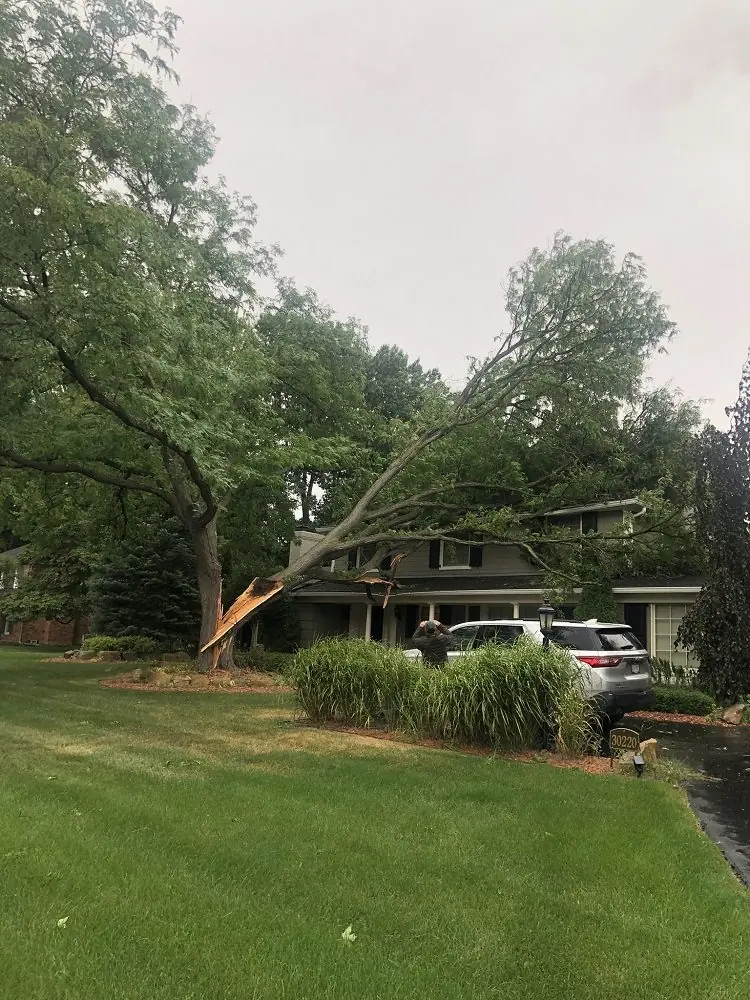
The first hour
Start with safety. Then document the damage and call for help.
- Treat every downed line as live: that includes one lying in the grass and one tangled in the branches. Never approach a tree that touches a wire. Call your utility first: DTE Energy at 800-477-4747 or Consumers Energy at 800-477-5050. If a line is on a person or a vehicle, call 911.
- Get people out from under it: a limb resting on a roof is holding tension and can shift without warning, especially in wind. Keep kids and pets away from the rooms under the damage.
- Photograph everything before anything moves: take wide shots from the street, close-ups of where the tree meets the house, several angles, and any damage inside. Your insurance claim will rest on these pictures.
- Do not start cutting: a loaded limb stores energy and releases it in directions nobody can predict. Cutting first is how a damaged roof becomes a destroyed one, and how people get hurt.
- Call your insurer early, even before you know the full extent. Opening the claim fast never hurts you. Waiting sometimes does.
A tree down in the yard may not need emergency work if it is stable and away from people, buildings and wires. Keep clear, take photos from a safe distance and call me to discuss the next step.
How to reach me after hours
Office hours are Monday to Friday 8 a.m. to 6 p.m. and Saturday 9 a.m. to 2 p.m. Outside those hours, and on Sundays, the same number reaches me: 248-672-8058. Call first. If I don’t pick up, I am on another emergency, so text your address, what the tree is resting on and one photo.
After a major storm, I prioritize trees on homes, occupied vehicles and the only access to a property. I handle other immediate hazards next, then schedule general cleanup.
When you call, tell me what the tree is resting on, whether anyone is in danger and whether a wire is involved.
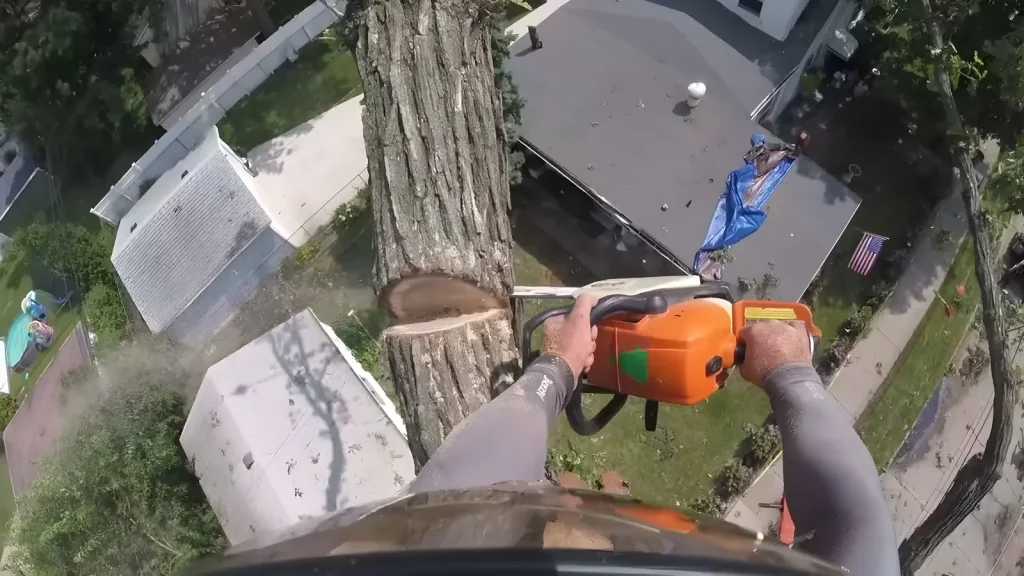
What emergency work costs compared with scheduled work
Emergency work has no minimum charge or minimum hours. It starts at $250 per hour. The equipment and time required affect the total. Crane work starts at $3,500. I explain the scope and price before work begins when conditions allow.
Most planned removals in Oakland County run $600 to $5,000. Cabling is typically around $400 per cable. The estimate depends on the tree and access.
| The same tree | Handled before the storm | Handled after it fails |
|---|---|---|
| Dead ash over the garage | Planned removal on a calm January day, $600 to $5,000 | Emergency work from $250 an hour with no minimum, often crane work, plus your roof deductible |
| Silver maple with a weak fork | Cable and brace, about $400 | Emergency call, roofing contractor, insurance claim |
| Leaning oak, soil heaving on one side | Risk assessment, then a decision | Whatever it lands on decides the bill |
Same trees, very different bills, which is the case for the risk assessment and pruning work I do the rest of the year. See all tree services for the full list.
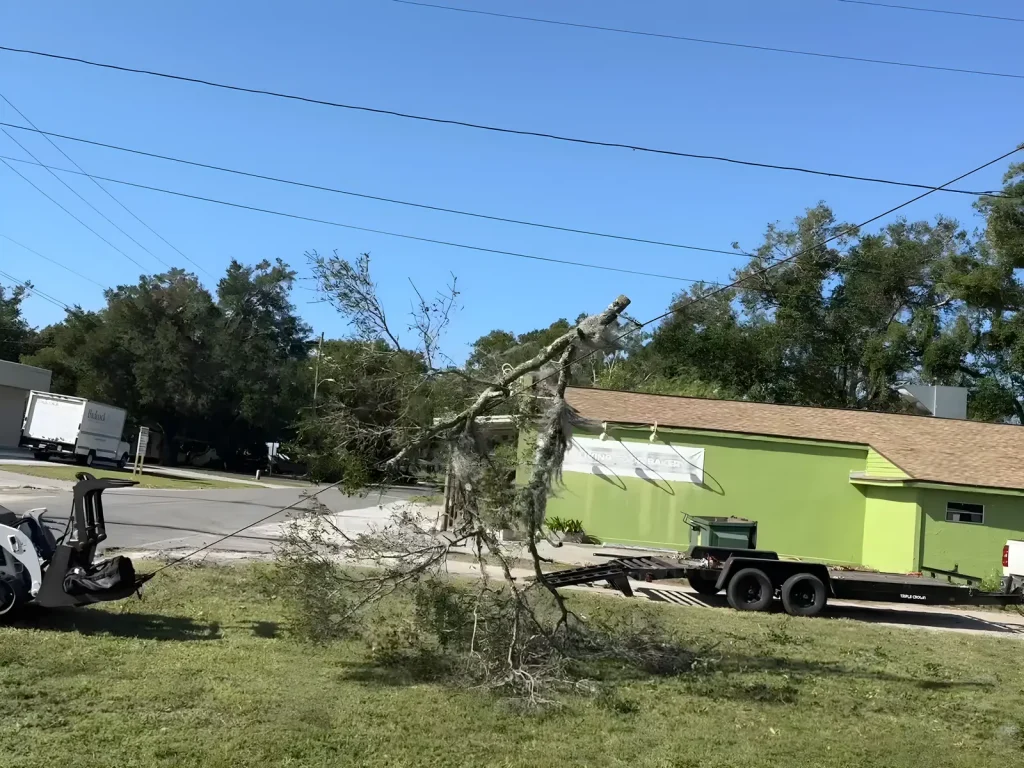
Getting the insurance claim paid
Coverage depends on your policy and what the tree damaged. A tree that hits a covered structure may be covered; one that falls in the yard without damaging anything may not be. Check your policy and call your insurer before assuming a cost is covered.
The order that works is simple: photograph first, call your insurer and open the claim, then call me. The crew stabilizes and removes the tree, and we photograph again as we go. Then I hand you the paperwork the adjuster asks for.
Photographs from before the work started. Yours plus ours, dated.
A written scope describing what was done and why, on the invoice.
Proof the contractor was insured. Tree Pros is licensed and insured.
I can provide the work scope, photos and certificate of insurance. Ask me if your adjuster needs anything specific.
If a neighbor’s healthy tree falls on your property in a storm, Michigan generally treats that as an act of nature. Your own policy handles it. If the tree was visibly hazardous and the owner knew, that changes. The Michigan tree law guide walks through it.
Why the same trees fall in every storm
Some conditions can make a tree more likely to fail in a storm. These are worth checking from a safe distance:
- Dead ash left standing: ash killed by emerald ash borer turns brittle within a couple of seasons and goes early in any wind. The emerald ash borer guide explains why a dead ash costs more every year it stands.
- Silver maple: it grows fast, attaches weakly and sheds big limbs.
- Twin trunks meeting in a tight V: the joint is bark, not wood, so the trunks were never joined, and it splits.
An arborist can see most of this a season or two before it fails. The guide to dying and dangerous trees shows what to look for from the ground. Late summer, before the leaves drop, is the best time to check. The 5 warning signs before fall storm season covers what to walk your yard for in August.
The storm calendar in Oakland County
Damage comes in four seasons, and each one breaks trees differently.
- Late spring and summer: severe thunderstorms with straight-line winds do most of the damage here, and full canopies catch wind like sails.
- Fall: long wind events arrive while the leaves are still on, and weak forks and deadwood that survived summer go now.
- Winter. Ice loads every limb at once. Soft-wooded trees like silver maple shed under the weight.
- Spring. Saturated soil loosens root plates. A tree that leaned for years can go over in a moderate wind once the ground is soft.
Anything found in August can be handled on a schedule, before the fall wind and winter ice arrive.
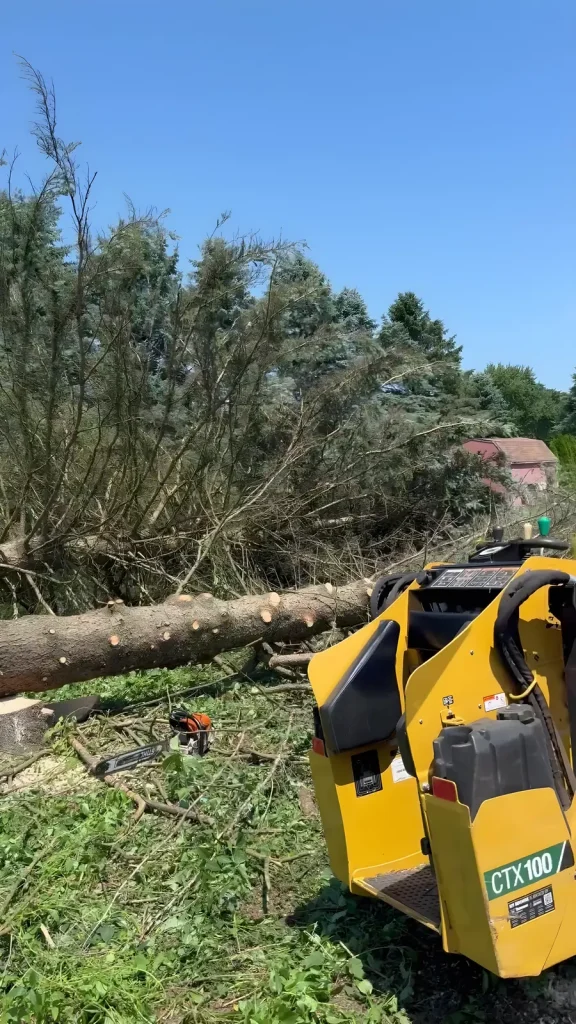
When a tree is too large, too close or too decayed to work from a rope, I bring a crane. The tree comes off in sections, so nothing else lands on the roof, and I can grind the stump once the tree is off. The tree removal page covers how planned removals work and what is included.
What customers say after the storm
5.0 stars from 17 Google reviews. Every review below is copied word for word from the Tree Pros Google listing, where you can read all of them.
- “Everything was taken care of quickly and he had everything cleaned up as if nothing happened in only a few hours.…”
Nick J. · July 2026 · Google review - “Rob and his crew did an amazing job. They were very professional, timely and exercised safety at every step of the process. The cleanup at the end of the job was excellent.”
Ron S. · May 2026 · Google review - “I have been a repeat customer since 2019 and will continue to only work with Tree Pros. I have always been 110% satisfied with the timeliness, quality of work and professionalism. A couple of the trees I had taken down were massive and in tight spots between houses. Tree pros was able to take them down with no issue. Thank you Rob and team for the focus and hard work you guys do to keep my properties safe.”
Robert R. · May 2026 · Google review
Emergency questions we get after every storm
Do you come out at night, on weekends, or on holidays?
Yes, for structural emergencies: a tree on a house, on an occupied vehicle, or blocking the only way in or out. Call or text 248-672-8058 at any hour. A tree in the yard that touches nothing is not an emergency, and scheduling it gets you a better price. When I am on another emergency, text the address, what the tree is resting on and one photo. I call back in order of severity.
Should I call the utility or the tree service first?
The utility, if any wire is involved. Call DTE Energy at 800-477-4747 or Consumers Energy at 800-477-5050, and call 911 if a line is on a person or a car. Tree crews can’t work on or near energized lines, and neither can you. Once the utility has made the line safe, call me. With no wire involved, call me first and your insurer second, and photograph everything before either call.
What do you charge for emergency tree removal?
Emergency jobs start at $250 an hour. There is no minimum charge and no minimum hours, so you pay for the time the job takes. Night work, a crane and wires near the tree raise the cost, because they add equipment and time. If a crane is required, expect the job to start around $3,500. A planned removal runs $600 to $5,000 for most Oakland County trees. If a wire is down, call 911 and the utility before you call me. DTE advises staying at least 25 feet back and treating every downed line as live. When the tree damaged a covered structure, your homeowners policy usually pays for the removal, less your deductible. I give you a written scope and photos for the adjuster.
Will homeowners insurance cover the removal?
It depends on your policy and what the tree hit. The Insurance Information Institute says homeowners policies generally cover removal when a tree damages a covered structure, up to policy limits. A tree that falls without hitting anything may not be covered. Photograph the damage from a safe place, call your insurer and ask about your deductible and debris limit.
Do I need a permit to remove a tree in an emergency?
Permit rules vary by community, and emergency work may be treated differently from planned removal. If the tree has damaged a structure, address immediate safety first. I can check with the city about any follow-up once the site is safe. The tree removal permit guide covers planned work.
Tree removal and crane work →Book a risk assessment →Signs a tree is dangerous →Michigan tree law: who pays →What tree removal costs →Tree service across Oakland County →All tree care guides →
I run storm calls across the county. That covers lake communities like Waterford and Commerce Township, the tight lots of Birmingham and the big silver maples of Troy.
Tree on your house, driveway or vehicle?
Call or text 248-672-8058 for a storm emergency, any hour.