
Michigan Tree Law: Neighbors, Overhanging Branches, and Who Pays
Updated September 7, 2026 · Written by Rob Burgund, ISA Certified Arborist MI-4857A
- ISA Certified Arborist MI-4857A
- Working in Oakland County since 2013
- Licensed and insured
- 5.0 stars from 16 Google reviews

Written by Rob Burgund
ISA Certified Arborist · MI-4857A
Rob writes the tree risk assessments that homeowners use to settle neighbor questions. He has been doing tree work in Oakland County since 2013. More about Rob and Tree Pros, or verify the certification in ISA’s public directory.
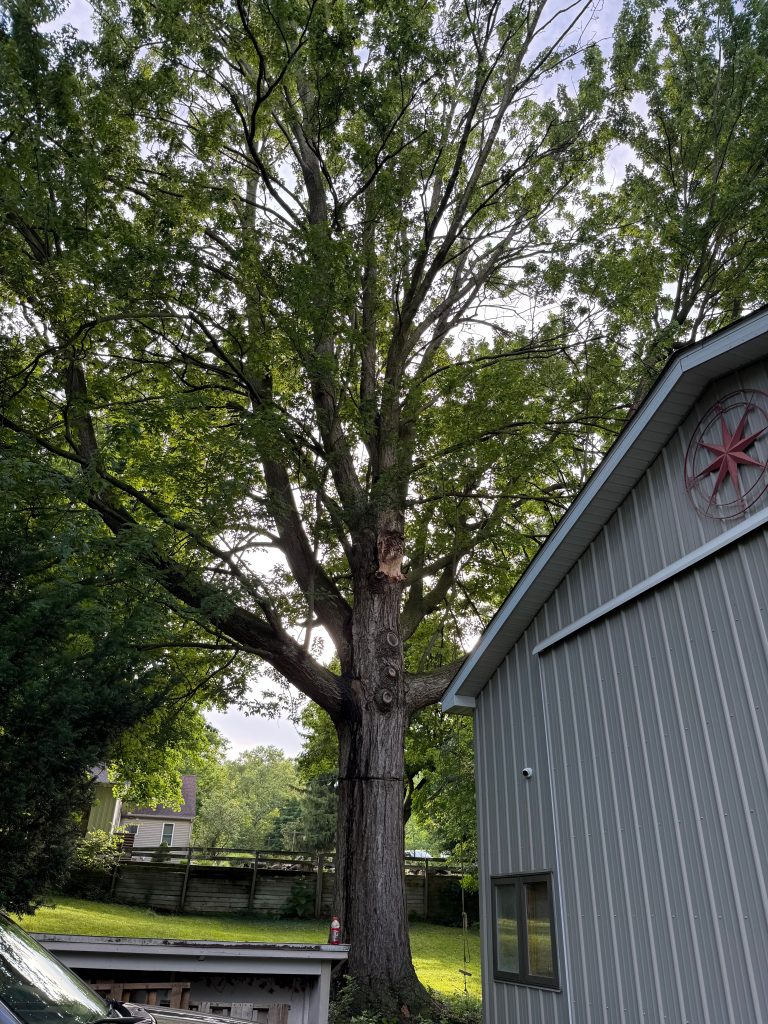
Tree disputes turn on their specific facts, and outcomes vary. For anything contested or expensive, talk to a Michigan property attorney. What follows is the general framework as it is commonly applied, which is enough to know which question you are actually facing.
Who owns the tree?
Ownership follows the trunk. If the trunk stands entirely on your neighbor’s land it is their tree, even if half the canopy shades your yard and every leaf ends up in your gutters.
If the trunk straddles the boundary line, the tree is generally treated as jointly owned, and neither of you can remove it without the other’s agreement.
Can I cut the branches hanging over my property?
Generally yes, because Michigan recognizes the right to handle it yourself. The limits are firm.
- Only up to the property line. You can cut what is over your side. You cannot reach past the boundary, and you cannot step onto their land to do the work without permission.
- You cannot harm the tree. If your trimming kills it or seriously damages it, you can be sued for the value of the tree and, in serious cases, charged. Michigan takes destruction of someone else’s tree seriously, and the damages can dwarf what the work would have cost done right.
- You pay for it. Your neighbor has no obligation to fund trimming that benefits you.
“I cut everything on my side” sounds airtight, and it is how most of these fights begin. Strip one whole side off a mature tree and you can destabilize it or kill it, at which point the fact that every cut was technically over your land stops protecting you. Have the work done properly by someone who knows how much a tree can lose, and have the conversation with your neighbor before the saw shows up. This comes up constantly on the tight lots of Royal Oak, Birmingham and Walled Lake, where a big maple can shade three yards at once.
A tree fell and caused damage. Who pays?
This is the question we hear most after every storm, and the answer surprises almost everyone.
| The situation | Who is generally on the hook |
|---|---|
| A healthy tree fails in a storm and damages the neighbor’s property | Treated as an act of nature. The damaged party claims on their own insurance, and the tree’s owner is not automatically liable |
| A visibly hazardous tree fails, and the owner knew | The tree’s owner may be liable. Knowledge of the hazard is the pivot point |
| The neighbor warned the owner in writing and nothing was done | Strengthens the case against the tree’s owner considerably |
| The tree falls and damages nothing | Whoever owns the trunk handles the cleanup |
For what to do in the first hour after a tree lands on a house, and what the insurance adjuster will ask for, see our storm damage page.
Why documentation decides these cases
Everything above pivots on one question. Did the owner know? That cuts in both directions, and both are worth acting on today.
If a neighbor’s tree worries you, say so in writing. An email is enough, and keep a copy with a dated photo. That single step converts “nobody could have known” into documented notice.
If a neighbor has raised concerns about your tree, get a professional assessment. If the tree is sound, you now hold written evidence that a certified arborist said so. If it is not, you found out before it became a claim instead of after. Our written tree risk assessment is $399, and our guide to dangerous trees shows what the assessment looks for.
Boundary trees
Where the trunk sits on the line itself, both owners have an interest and neither can act alone. Work costs are usually split by agreement.
If you are thinking about removing a boundary tree, get the conversation and ideally the agreement in writing first. Removing a jointly owned tree without consent is one of the most expensive mistakes in this whole area of law.
City ordinances sit on top of all this
Everything above is about you and your neighbor. Your city may have its own opinion. Several Oakland County communities regulate removal, and sometimes heavy pruning, of protected trees, and the strip between the sidewalk and the street is almost always a city tree no matter who mows around it. The permit guide lists the rules community by community.
What customers say
5.0 stars from 16 Google reviews as of October 2026. Every quote below is copied word for word from our Google listing, where you can read all of them.
- “I have been a repeat customer since 2019 and will continue to only work with Tree Pros. I have always been 110% satisfied with the timeliness, quality of work and professionalism. A couple of the trees I had taken down were massive and in tight spots between houses. Tree pros was able to take them down with no issue. Thank you Rob and team for the focus and hard work you guys do to keep my properties safe.”
Robert R. · May 2026 · Google review - “Rob and his crew did an excellent job. They were polite, professional, and took the time to listen to what I wanted. I appreciated that Rob shared his knowledge and helped me make the right decisions about my trees without ever making me feel pressured.…”
Claire B. · July 2026 · Google review - “Tree Pros removed several trees at my work place and trimmed a couple of trees at my home. Rob, his team, and work fleet are professional in appearance and excellent in performance. They did a great job and cleaned up the yard before leaving. If you are in need of tree work, this is the company you call.”
Mike P. · July 2026 · Google review
Neighbor questions we hear most
Can I make my neighbor trim their tree?
Usually not. In Michigan a tree belongs to the owner of the ground its trunk grows from, and that owner has no general duty to prune it for your benefit. Leaves, shade and ordinary branches over your yard are treated as part of living near trees. There are two exceptions. If the tree is demonstrably hazardous, a dead limb over your roof or a trunk with a crack in it, the owner can become liable for damage once they know about it, so a written notice from you with a dated photo changes their position and often gets the work done. And if a local ordinance protects or regulates the tree, the city may step in. Short of those, what you can do is trim the part that is over your property line, at your own cost, without stepping onto their land and without harming the tree. Having a certified arborist do that trimming is the cheapest insurance against the dispute that follows a botched cut.
Their leaves fill my gutters every fall. Any recourse?
Realistically, no. Michigan treats leaf litter, fruit and needles as a normal part of living near trees.
Do I need my neighbor’s permission to trim overhanging branches?
Not for the portion over your property. You do need permission to set foot on their land, and you must not harm the tree in the process.
What if the tree is protected by a city ordinance?
The ordinance wins, even on your own land and even for a tree you own outright. Check the rules for your community before anyone cuts, and if the tree is your neighbor’s, the permit is theirs to pull, not yours.
A neighbor cut down my tree. What can I recover?
Michigan law allows a tree’s owner to recover up to three times the tree’s value from whoever cut it (MCL 600.2919), and on a mature specimen that is not a small number. A 60-foot oak that took longer to grow than you have been alive has real appraised value, and tripling it makes a big number. Willful destruction can also carry criminal exposure under MCL 750.382. The same rules apply in reverse if your trimming kills a neighbor’s tree, which is why “I only cut my side” is not a defense once the tree is dead. If it has happened to you, photograph the stump and the site from several angles today, keep every text and email, and ask a certified arborist to document the species, the trunk diameter and the condition of the wood before the stump is ground or removed. Then talk to a Michigan property attorney. The evidence disappears fast, and the case rests on it.
Who pays when a neighbor’s tree falls on my house?
Usually your own homeowners insurance, and it surprises people. When a healthy tree fails in a storm, Michigan treats it as an act of nature: the damaged party claims on their own policy, and the tree’s owner is not automatically liable, even though it was their tree. The picture changes when the tree was visibly hazardous and the owner knew. A dead tree, a trunk with a long crack, a limb that has been hanging over your roof for a year, especially if you told them in writing, can shift the cost to them or their insurer. That is why the written notice matters so much before anything falls, and why photographs of the tree’s condition before removal matter so much after. Our storm damage page covers what to photograph and what the adjuster will ask for.
Permit rules by community →Signs a tree is dangerous →Book a written risk assessment →All tree care guides →
Need a tree assessed, or documented?
A written arborist assessment settles neighbor conversations, satisfies insurers, and puts the facts on paper before anyone needs a lawyer.