
Emerald Ash Borer in Michigan: Can Your Ash Tree Be Saved?
Updated September 7, 2026 · Written by Rob Burgund, ISA Certified Arborist MI-4857A
- ISA Certified Arborist MI-4857A
- Working in Oakland County since 2013
- Licensed and insured
- 5.0 stars from 16 Google reviews
Written by Rob Burgund
ISA Certified Arborist · MI-4857A
Rob owns Tree Pros, LLC in Bloomfield Township and is the arborist who quotes and works every job. He has been doing tree work in Oakland County since 2013. More about Rob and Tree Pros, or verify the certification in ISA’s public directory.
This one started in our backyard. Emerald ash borer was first found in North America in southeast Michigan in 2002, detected at the same time across the river in Windsor.
Researchers later concluded it had been quietly established since the early-to-mid 1990s. The region has since lost the overwhelming majority of its untreated ash.
What is left is a mix. A small number of trees on protection programs, and a much larger number of standing dead ash that nobody has dealt with yet. We see the second kind every week in Pontiac, Waterford and the older subdivisions of Troy.
Can this tree be saved?
| Canopy loss | Realistic outcome | What we would advise |
|---|---|---|
| Under 10% | Treatment generally works well | Treat, and stay on schedule |
| 10 to 30% | Diminishing odds. May recover, may not | Assess carefully. On a valuable tree, treatment is a reasonable bet |
| 30 to 50% | Uncertain, but not hopeless | MSU bulletin E-2955 supports treating dieback in the 20 to 40% range. Worth a real assessment before writing the tree off |
| Over 50 to 60% | Very unlikely to benefit | Removal, and sooner is cheaper than later. This is where the published guidance says it is too late |
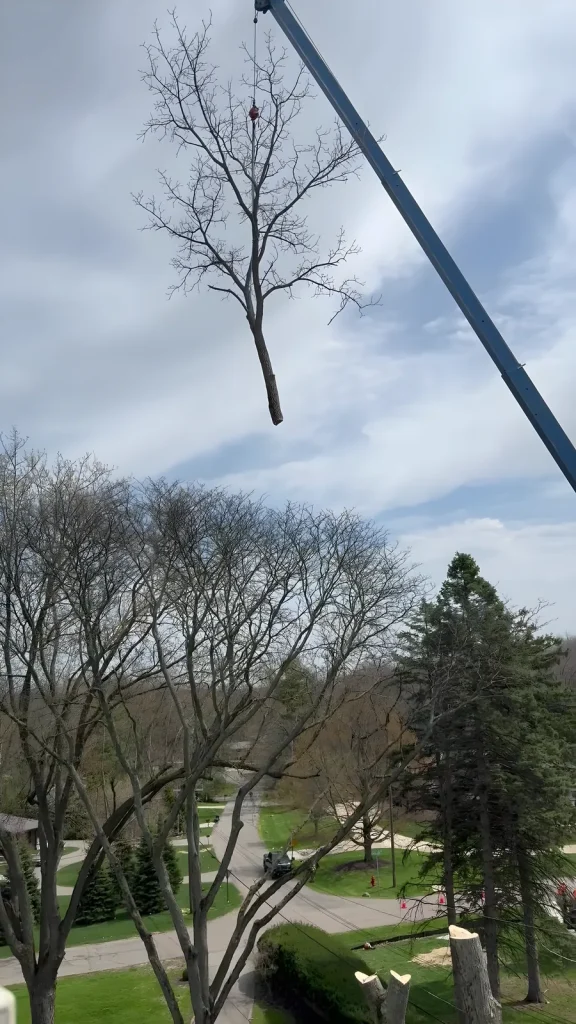
Dead ash does not stay climbable. Research in Arboriculture & Urban Forestry documents the wood weakening within one to two years of infestation, with branches failing right at the trunk, a failure mode not seen in healthy ash. A tree a climber could have dismantled last year may need a crane this year, and that is frequently a four-figure difference on the same tree. Removal pricing is on our tree removal page.
What treatment actually involves
The effective option for a tree worth saving is a trunk injection of emamectin benzoate, an insecticide the tree moves through its own tissue so it reaches the larvae feeding under the bark.
Research summarized by MSU and the USDA Forest Service shows a single injection reliably protects for about two years and often three. The 2019 edition of the multistate EAB bulletin reports near-complete control for three years from one application. The standard re-treatment interval remains every two years.
Two things to understand before you commit.
It is a subscription, not a purchase. Protection lapses, and one missed cycle can undo years of investment. Budget for it as a recurring cost on a tree you genuinely value.
Early infestation hides well. EAB is often thoroughly established before symptoms show, which means protective treatment sometimes starts on a tree that is already declining. An assessment before the first injection is worth the small cost.
The signs you are looking for
- Thinning from the top down, with dieback starting in the upper third of the crown.
- Water sprouts shooting from the trunk and lower limbs. A distress flare.
- D-shaped exit holes, about 3 to 4 mm across, roughly an eighth of an inch. The flat-sided shape is the diagnostic detail, because round holes are a different insect.
- Serpentine galleries, which are winding S-shaped tunnels under loose bark.
- Woodpecker flaking high in the tree. A common early tell, though it usually shows in the second year, and woodpeckers chase other borers too.
- Vertical bark splits with galleries visible beneath.
Not sure the problem is EAB at all? Our guide to dying and dangerous trees covers the general signs for any species, and the oak wilt guide covers Michigan’s other big tree killer.
If the tree is already dead
Standing dead ash is the most dangerous routine removal in this trade. The wood fails unpredictably, which rules out climbing, and it fails while people are working underneath it.
Any experienced crew prices a dead ash above a live tree of the same size. A crew that does not is either green or about to take a risk on your property that you would never have agreed to.
Dead ash is also the first thing to come down in a windstorm, which is why so many of our storm calls are ash that had been dead for years.
What customers say about our removals
5.0 stars from 16 Google reviews as of October 2026. Every quote below is copied word for word from our Google listing, where you can read all of them.
- “Rob did an excellent job removing a couple trees on our property. He was professional, knowledgeable, and very easy to work with throughout the entire process. The work was done safely, efficiently, and the cleanup afterward was spotless. You can tell he takes pride in his work and cares about doing the job right. I would absolutely recommend Rob to anyone looking for a reliable arborist.”
Garret A. · May 2026 · Google review - “Tree Pros removed several trees at my work place and trimmed a couple of trees at my home. Rob, his team, and work fleet are professional in appearance and excellent in performance. They did a great job and cleaned up the yard before leaving. If you are in need of tree work, this is the company you call.”
Mike P. · July 2026 · Google review - “I have been a repeat customer since 2019 and will continue to only work with Tree Pros. I have always been 110% satisfied with the timeliness, quality of work and professionalism. A couple of the trees I had taken down were massive and in tight spots between houses. Tree pros was able to take them down with no issue. Thank you Rob and team for the focus and hard work you guys do to keep my properties safe.”
Robert R. · May 2026 · Google review
Ash questions we hear most
Is it worth treating my ash tree?
Often yes, if three things are true: canopy loss is still under about 10 to 20%, the tree is structurally sound, and it matters to the property for shade, screening, or the way the yard looks. Treatment is a trunk injection of emamectin benzoate that protects for about two years, often three, and it has to be repeated every two years for as long as you want the tree. Past 50 to 60% canopy loss, the published evidence says treatment no longer helps, and removal is the smarter spend, because a dead ash gets more expensive to take down every season it stands. Between those two points it is a judgment call, and MSU bulletin E-2955 supports treating trees with 20 to 40% dieback. Get it assessed rather than guessing; the assessment costs far less than either wrong answer.
How often does the treatment repeat?
The injection protects for about two years, often three. Plan on re-treating every two.
Can I treat it myself?
Soil drenches are sold to homeowners, but trunk injection, the option that actually works on larger trees, takes professional equipment and licensing.
My ash has been dead for years. How urgent is this really?
More urgent than most people think. Research in Arboriculture & Urban Forestry documents ash wood degrading within one to two years of infestation, with branches failing right at the trunk. That does two things. It makes the tree dangerous to everyone under it, especially in wind, and it takes climbing off the table, so a tree that could have been dismantled by a climber last year may need a crane this year at a four-figure difference. It also matters legally: Michigan generally does not hold an owner liable when a healthy tree fails in a storm, but a known dead tree left standing is a different case. If your ash has been dead more than a year, get it assessed and scheduled on a calm day rather than waiting for a storm to schedule it for you.
Should I replant with another ash?
No. Plant something else. Emerald ash borer is still here, and an untreated young ash will meet the same end as the one you just lost. Hackberry, Kentucky coffeetree and oak are all sound choices for Oakland County, and tulip poplar works in southern Michigan, though it is rated hardy only to about zone 4-5 in the coldest parts of its range and is somewhat weak-wooded. If you go with an oak, remember the no-pruning window from April 15 to July 15 because of oak wilt. Give the new tree a few feet of distance from where the old stump was ground, since the buried grindings temporarily tie up nitrogen as they break down. The real lesson EAB taught this region is diversity: streets planted with one species lose every tree at once.
Tree removal and crane work →What a dead ash costs to remove →What removal costs →Signs a tree is dying or dangerous →Oak wilt in Michigan →All tree care guides →
Get your ash assessed
We will tell you straight whether treatment is worth the money or removal is the smarter call.