
How to Plant a Tree the Right Way in Oakland County
Updated September 2026 · Written by Rob Burgund, ISA Certified Arborist MI-4857A
- ISA Certified Arborist MI-4857A
- Working in Oakland County since 2013
- Licensed and insured
- 5.0 stars from 15 Google reviews

Written by Rob Burgund
ISA Certified Arborist · MI-4857A
Rob owns Tree Pros, LLC in Bloomfield Township and is the arborist who quotes and works every job. He has been doing tree work in Oakland County since 2013. More about Rob and Tree Pros, or verify the certification in ISA’s public directory.
Why planting depth is the whole ballgame
The root flare is where the trunk widens out into the roots at ground level. Roots grow mostly sideways, not down. Michigan State University Extension notes that about 80 percent of a tree’s roots sit in the top 18 to 24 inches of soil, a wide, shallow pancake rather than a deep taproot. Those roots need to breathe. A common landscaper habit called a mulch volcano buries the flare under extra soil or a thick mound of mulch. Once that happens, the roots close to the surface cannot get enough air. The tree declines slowly: thinner growth, early fall color, dieback at the branch tips, sometimes years after planting.
Roots planted too deep also tend to circle back toward the trunk instead of spreading outward. A root that presses against the trunk, as both grow thicker, can eventually girdle it. That cuts off the tree’s own water and nutrient flow from the inside. By the time a girdling root shows on the surface, the damage underground has usually been building for years.
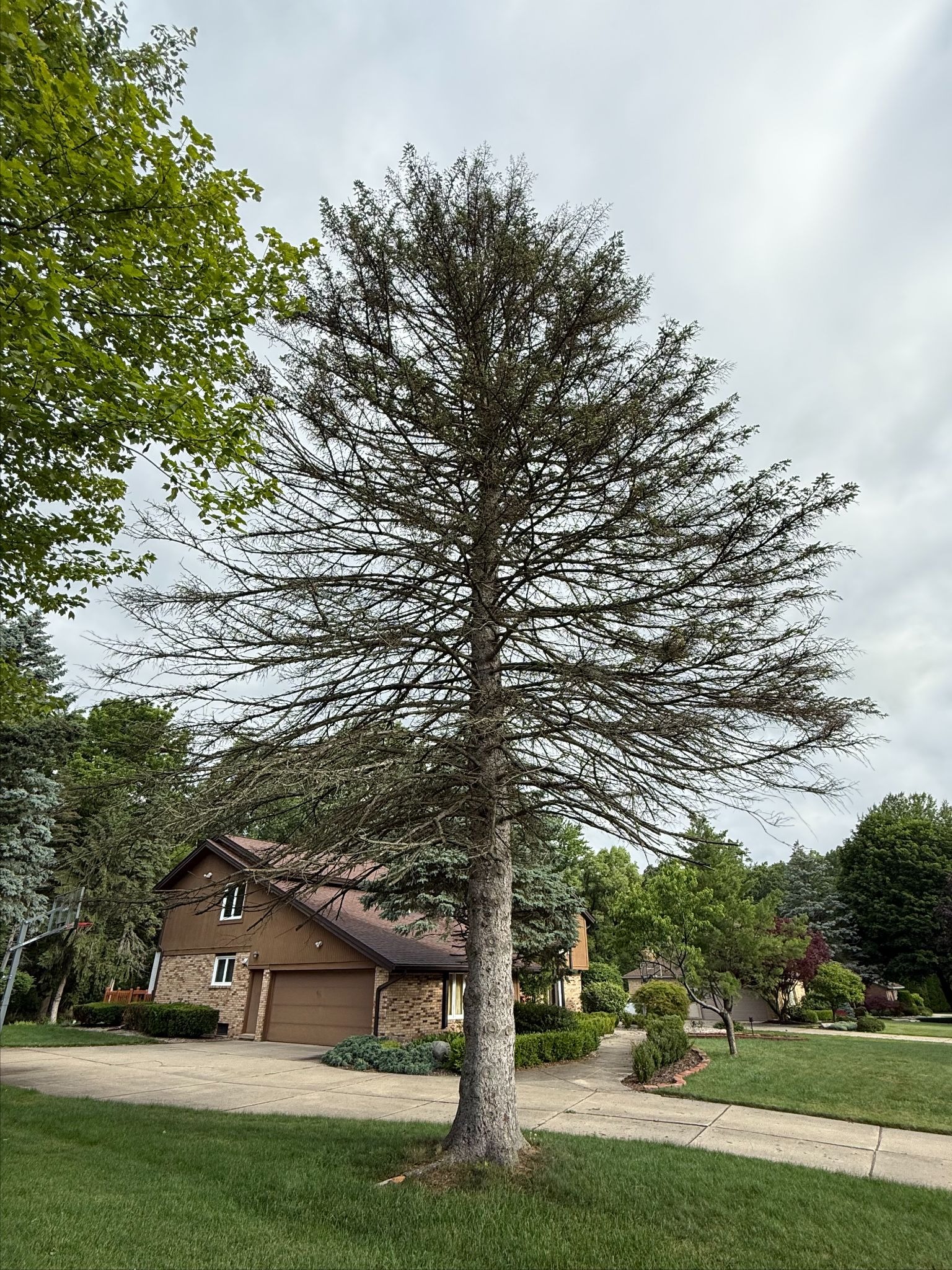
How to check the flare before you plant
Container-grown and balled-and-burlapped trees from a nursery almost always have extra soil piled over the actual root flare, which hides where it really is. Before the tree goes in the hole:
- Gently brush or hose away soil from the top of the root ball until you can see the flare, the point where the trunk visibly widens.
- Look for roots that are already circling the root ball, and straighten or cut them now rather than let them keep circling once planted.
- Set the tree so the flare sits level with, or very slightly above, the surrounding grade, not the top of the root ball or burlap.
The Michigan Department of Natural Resources gives the same guidance for the hole itself. Dig it saucer-shaped: only as deep as the root ball, but about three times as wide. Rough up the sides so new roots can push through instead of hitting a smooth wall. Cut away burlap and remove any plastic pot, wrap or tie completely before backfilling. It is worth digging a wider hole than feels necessary; a small, tight hole in heavy Oakland County clay does more harm than digging too generously.
Mulch, watering and staking
Add mulch 3 to 4 inches deep over the planting area, but leave a bare 6-inch ring right around the trunk. Mulch piled against the bark holds moisture there and invites the same kind of decay and pest pressure that a buried root flare does; a mulch ring, not a mulch volcano, is the goal. Water newly planted trees deeply and often through the first year, soaking the whole area under the branch spread rather than just the base of the trunk, and keep watering through the second year in a dry summer. The Michigan DNR does not recommend fertilizing at planting or for the first three years; a new tree’s priority is root establishment, not top growth.
Staking is optional and most new trees do not need it. Stake only if the site is windy or the crown is dense. Drive two stakes six to eight inches outside the root ball, on opposite sides. Tie the trunk loosely below the first branch with a wide strap, never wire. Remove the stakes after one year. A tree left staked for years develops a weaker trunk, since some trunk movement in wind is what builds the taper and strength a tree needs to stand on its own.
Picking a species that will not be a problem in twenty years
Emerald ash borer killed most of the untreated ash across this region because so much of the local tree stock was one species planted at scale. Michigan State University Extension’s guidance on tree selection comes down to matching the right plant to the right site. It also means avoiding monoculture: aim for no more than about 10 percent of any one species in a neighborhood or a planting plan. Several species are genuinely native to Michigan and well suited to home landscapes here. Red maple tolerates wet and acidic soils and colors well in fall. American hornbeam and ironwood handle tougher, shadier sites. Honeylocust, Kentucky coffeetree and serviceberry are also native, despite often being sold as ornamental introductions.
Whatever you plant, match the species to the actual site conditions, soil drainage, sun exposure, and how much room the mature canopy will need, rather than picking based on how a small nursery specimen looks today. A tree that outgrows its spot ends up needing the kind of aggressive pruning, or eventual removal, that proper species selection avoids entirely.
Do not plant a new tree where a stump was just ground
If you are replacing a tree lost to storm damage or emerald ash borer, do not plant directly in the same spot the old stump was ground out. Fresh wood chips and sawdust left in the ground tie up nitrogen as they decompose, competing with a new tree’s roots for the same nutrients right when it needs them most. Give it a few feet of clearance from the old root zone, or wait a season and amend the soil if the same spot is the only option.
Have us plant it for you →What to plant after losing an ash →Stump grinding before you replant →Tree health care and root flare excavation →
Frequently asked questions
How can I tell if my existing tree was planted too deep?
Look at where the trunk meets the ground. If it goes straight into the soil like a fence post, with no visible widening, the flare is likely buried. Dig gently with your fingers within an inch or two of the trunk; if you find only small roots and no flare in the first couple of inches of soil, it was planted too deep. This applies to a tree planted years ago just as much as one going in today.
What is the best time of year to plant a tree in Michigan?
Early spring or fall, per Michigan DNR guidance, gives roots time to establish before the stress of summer heat or winter cold sets in. Summer planting is possible but needs much more careful watering, since the tree is trying to establish roots while also under heat and drought stress.
Can I fix a tree that was planted too deep after the fact?
Often, yes, especially if it has only been a year or two. Rake back the excess soil and mulch down to the actual root flare, sloping what remains gently away from the trunk rather than piling it back on top. For a tree that has been buried for many years with girdling roots already developed, root flare excavation by an arborist can still help, though it will not undo damage that has already set in.
How much should I water a newly planted tree?
Deeply and regularly through the entire first growing season, more in hot, dry stretches, watering the full area under the branch spread rather than just at the trunk. Keep watering through the second year if rainfall runs below average. Established trees, three years and older, generally do not need supplemental watering except in a severe drought.
Should I fertilize a new tree to help it establish faster?
No. Michigan DNR guidance specifically advises against fertilizing at planting or for the first three years. A new tree’s energy needs to go into building roots, and fertilizer pushes top growth instead, which can actually slow root establishment and stress a tree that is not ready to support faster growth yet.
Planting, or replacing a tree you lost?
We plant at the correct depth, help pick a species suited to your site, and can walk you through first-year care. Free on-site estimates across Oakland County.