
Storm Damage and Emergency Tree Removal in Oakland County
Updated September 7, 2026 · 24/7 storm response, call or text 248-672-8058
- ISA Certified Arborist MI-4857A
- Working in Oakland County since 2013
- Licensed and insured
- 5.0 stars from 16 Google reviews

Written by Rob Burgund
ISA Certified Arborist · MI-4857A
Rob answers the storm line and runs the crew on site. He has been doing tree work in Oakland County since 2013. More about Rob and Tree Pros, or verify the certification in ISA’s public directory.
For everyone else, this is the storm playbook: the first hour, reaching us after hours, what your insurer will ask for, what emergency work costs, and why the same trees keep falling.
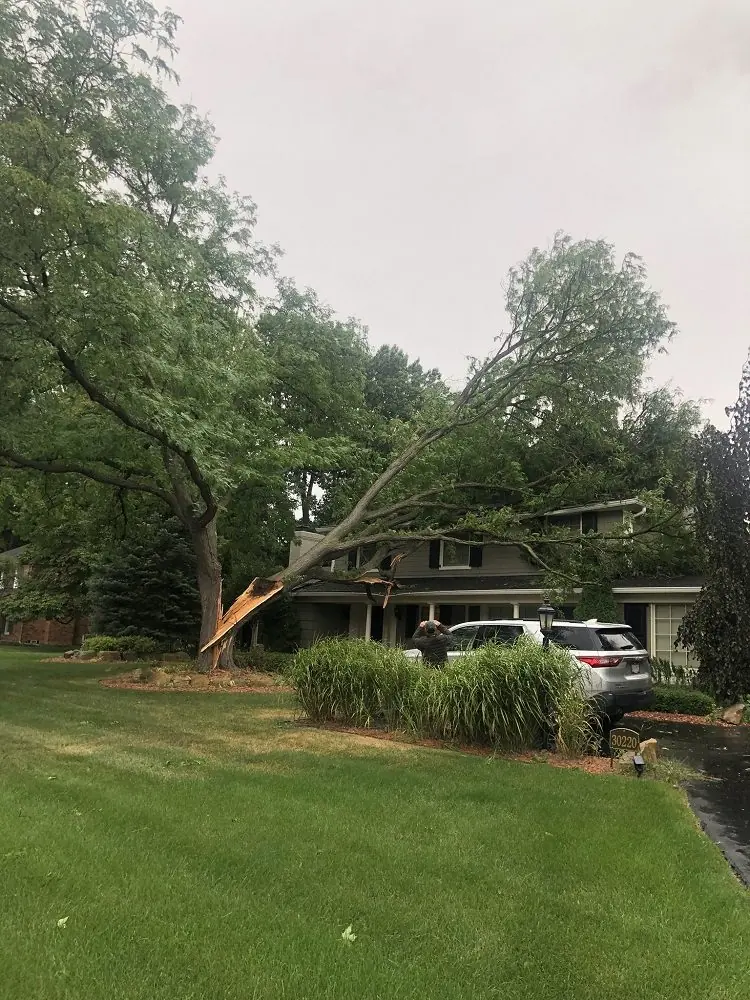
The first hour
Most of the damage we see after a storm was made worse in the first hour, usually by someone trying to help. Do these five things, in this order.
- Treat every downed line as live. That includes the one lying quietly in the grass and the one tangled in the branches. Never approach a tree that is touching a wire. Call your utility before anyone else: DTE Energy at 800-477-4747, Consumers Energy at 800-477-5050. If a line is on a person or a vehicle, call 911.
- Get people out from under it. A limb resting on a roof is holding tension and can shift without warning, especially while the wind is still blowing. Keep kids and pets inside and away from the rooms under the damage.
- Photograph everything before anything moves. Wide shots from the street, close-ups of where the tree meets the house, several angles, and any damage inside. Your entire insurance claim will stand on these pictures.
- Do not start cutting. A loaded limb stores energy and releases it in directions nobody can predict. Cutting first is how a damaged roof becomes a destroyed one, and how people get hurt.
- Call your insurer early, even before you know the full extent. Opening the claim fast never hurts you. Waiting sometimes does.
A tree down in the yard, a limb hanging over the lawn, a split trunk still standing: none of that needs a 2 a.m. crew. It needs photos, a phone call, and a scheduled visit at a scheduled price. We will tell you honestly which kind of job you have.
How to reach us after hours
Our office hours are Monday to Friday 8 to 6 and Saturday 9 to 2. Outside those hours, and on Sundays, the same number still reaches Rob: 248-672-8058. Call first. If we do not pick up, we are on another emergency, so send a text with your address, what the tree is resting on, and one photo.
After a county-wide windstorm, half of Oakland County calls in the same two hours. So we triage, and we are open about it. Trees on houses come first, along with trees on occupied vehicles and trees blocking the only way in or out of a property. Hazards that are stable but still threatening come second. General cleanup comes after that.
If your situation is urgent, say so, and be specific about what the tree is touching. That is how we get the order right.
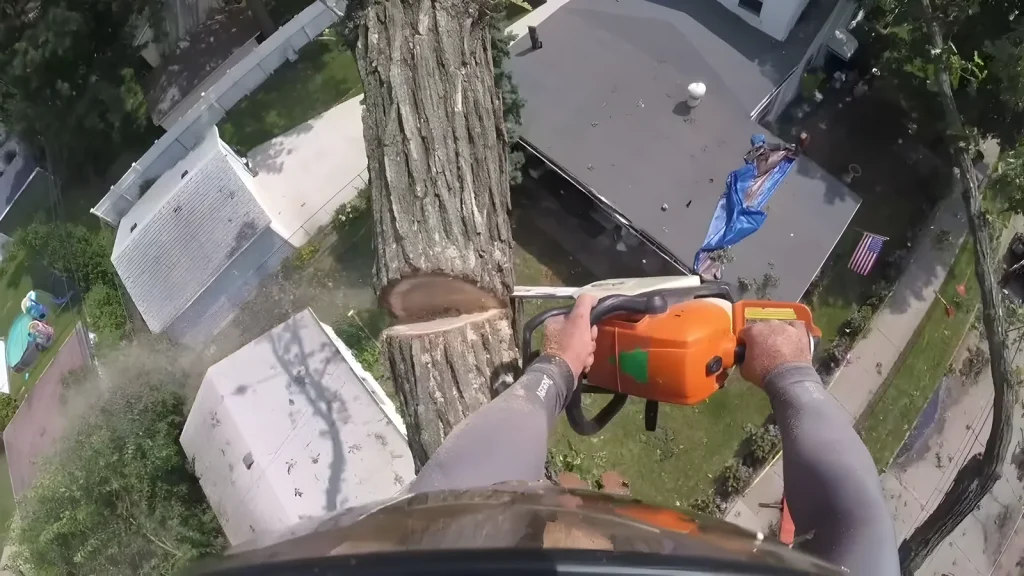
What emergency work costs compared with scheduled work
Emergency and storm work is billed on an eight-hour minimum, based on the equipment the job needs. A crane-assisted removal starts around $3,500. That is the honest price of pulling a crew and a crane off scheduled work, at night or on a holiday, to take a loaded tree off a roof without making the roof worse.
Scheduled work is a different world. Most planned removals in Oakland County run $600 to $2,500. A written tree risk assessment is $399, usually credited toward any work you go ahead with. Cabling a weak fork typically runs around $400.
| The same tree | Handled before the storm | Handled after it fails |
|---|---|---|
| Dead ash over the garage | Planned removal on a calm January day, $600 to $2,500 | Eight-hour emergency minimum, often crane work, plus your roof deductible |
| Silver maple with a weak fork | Cable and brace, about $400 | Emergency call, roofing contractor, insurance claim |
| Leaning oak, soil heaving on one side | Risk assessment, $399, then a decision | Whatever it lands on decides the bill |
Same trees, very different bills. That is the whole argument for the risk assessment and pruning work we do the rest of the year.
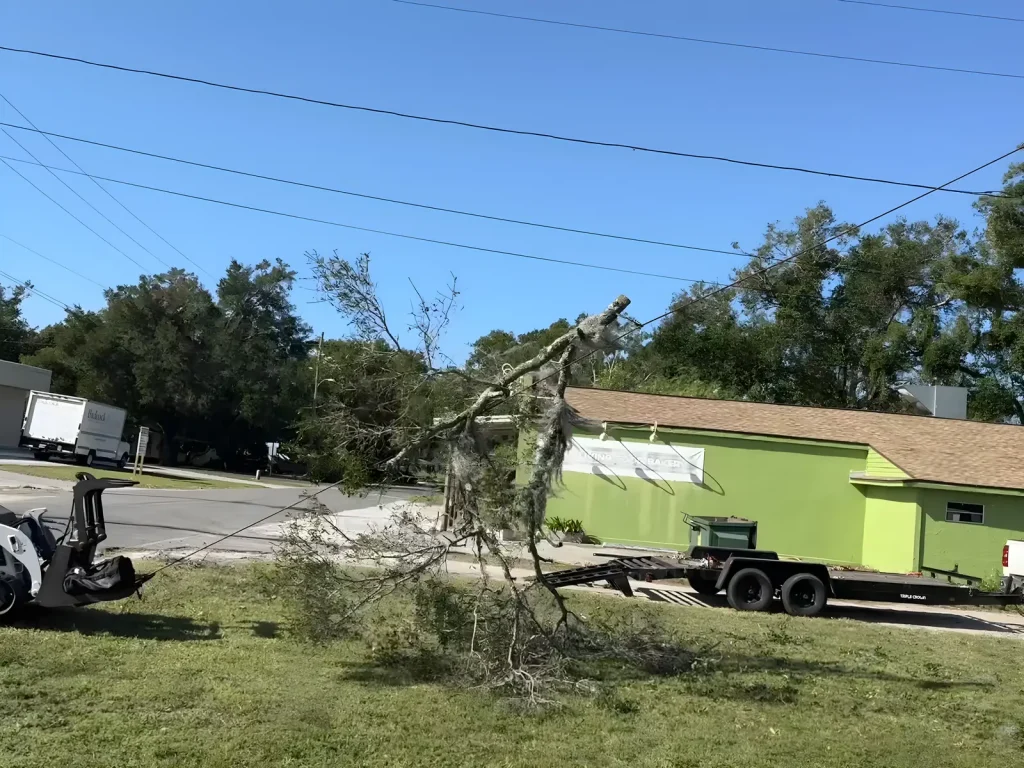
Getting the insurance claim paid
Generally, insurers cover removal when the tree caused damage to a covered structure: the roof, the garage, the fence, or a vehicle under comprehensive auto coverage. A tree that fell harmlessly in the yard usually is not covered, and neither is removing a tree just because it is dead or unwanted. Policies differ, so read yours.
Here is the order that works. Photograph first. Call your insurer and open the claim. Call us. We stabilize and remove the tree, and we photograph again as we go. Then we hand you the paperwork the adjuster is going to ask for.
Photographs from before the work started. Yours plus ours, dated.
A written scope describing what was done and why, on our invoice.
Proof the contractor was insured. We carry general liability and workers’ compensation coverage, and the certificates go in the file.
We provide all three as a matter of course, and we will talk to your adjuster directly if that helps. That paperwork is usually the difference between a claim that settles in days and one that drags on for months.
One more thing about who pays. If a neighbor’s healthy tree fell on your property in a storm, Michigan generally treats that as an act of nature, and your own policy handles it. If the tree was visibly hazardous and the owner knew, that changes. Our Michigan tree law guide walks through it.
Why the same trees fall in every storm
Downed trees are the leading cause of power outages across Southeast Michigan, and this county gets a lot of weather. The storms of July 3, 2026 left nearly 400,000 customers without power over the holiday weekend. Gusts ran 60 to 80 mph, with 62 mph recorded at Oakland County International Airport, and trees on lines drove most of the outages.
Yet the trees that come down are rarely random. After every storm we see the same three.
- Dead ash left standing. Trees killed by the emerald ash borer turn brittle within a couple of seasons and are among the first things flying in any wind event. Our EAB guide explains why a dead ash gets more expensive every year it stands.
- Silver maple. Fast-grown and weakly attached, the region’s most reliable shedder of enormous limbs.
- Twin trunks meeting in a tight V. The joint is bark, not wood, which means the trunks were never truly connected. It splits.
Nearly all of it is visible to an arborist a season or two before it fails. Our guide to dying and dangerous trees shows you what to look for from the ground. Late summer, before the leaves come down, is the best time to check: our 5 warning signs before fall storm season covers what to walk your yard for in August.
The storm calendar in Oakland County
The damage comes in four seasons, and each one breaks trees differently.
- Late spring and summer. Severe thunderstorms with straight-line winds do most of the damage here. Full canopies act as sails, and the July 3 storm is the recent example.
- Fall. Long wind events arrive while the leaves are still on. Weak forks and deadwood that survived summer go now.
- Winter. Ice loads every limb at once. Silver maple and other soft-wooded trees shed under the weight.
- Spring. Saturated soil loosens root plates. A tree that leaned for years can go over in a moderate wind once the ground is soft.
That is why late summer is the right time to have trees looked at. Anything found in August can be dealt with on a schedule, before the fall wind and the winter ice arrive.
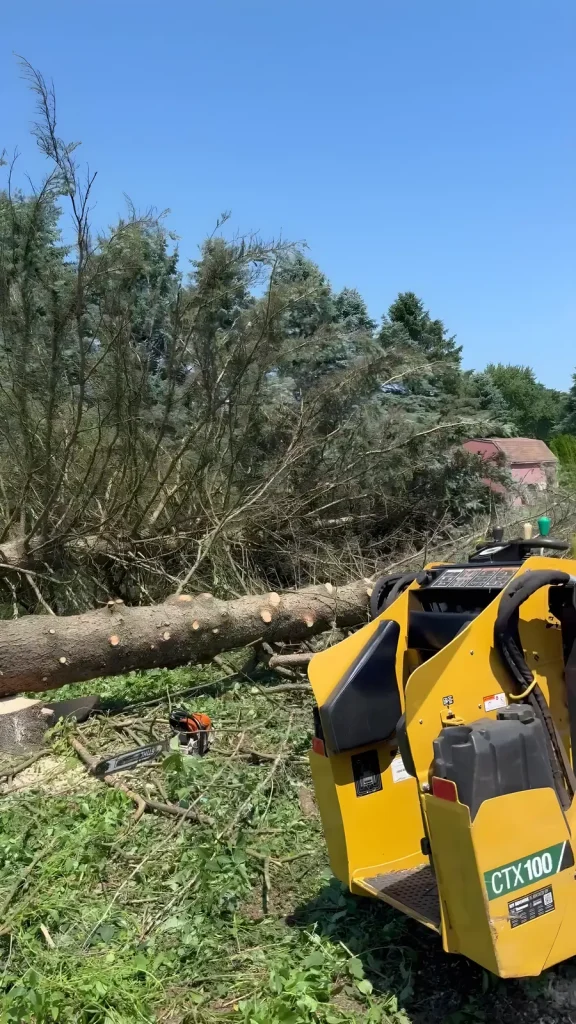
When a tree is too large, too close, or too decayed to work from a rope, we bring a crane, and the tree comes off in sections so nothing else lands on the roof. Once it is off, we can grind the stump the same day. Our tree removal page covers how planned removals work and what is included.
What customers say after the storm
5.0 stars from 16 Google reviews as of October 2026. Every review below is copied word for word from our Google listing, where you can read all of them.
- “We had an extremely large tree fall the night before the Fourth of July holiday. Rob and his team not only came out right away the morning of the Fourth, but also did an amazing job. Everything was taken care of quickly and he had everything cleaned up as if nothing happened in only a few hours. We always ask for multiple quotes on any house job and his was lower than any other quote we received. 10/10 work and will definitely be calling Tree Pros for all of our tree needs going forward.”
Nick J. · July 2026 · Google review - “Rob and his crew did an amazing job. They were very professional, timely and exercised safety at every step of the process. The cleanup at the end of the job was excellent.”
Ron S. · May 2026 · Google review - “I have been a repeat customer since 2019 and will continue to only work with Tree Pros. I have always been 110% satisfied with the timeliness, quality of work and professionalism. A couple of the trees I had taken down were massive and in tight spots between houses. Tree pros was able to take them down with no issue. Thank you Rob and team for the focus and hard work you guys do to keep my properties safe.”
Robert R. · May 2026 · Google review
Emergency questions we get after every storm
Do you come out at night, on weekends, or on holidays?
Yes, for structural emergencies: a tree on a house, on an occupied vehicle, or blocking the only way in or out. Call or text 248-672-8058 at any hour. Nick J. had a large tree come down the night before the Fourth of July in 2026, and we were there the morning of the holiday. If a tree is down in the yard and not touching anything, it is not an emergency, and you will get a better price by scheduling it. When we are already on another emergency, text the address, what the tree is resting on, and one photo. We call back in order of severity.
Should I call the utility or the tree service first?
If any wire is involved, the utility comes first, every time. Call DTE Energy at 800-477-4747 or Consumers Energy at 800-477-5050, and call 911 if a line is on a person or a car. Tree crews are not allowed to work on or near energized lines, and neither are you. Once the utility has made the line safe, call us and we take it from there. If no wire is involved, call us first and your insurer second. Photograph everything before either call.
What do you charge for emergency tree removal?
Emergency and storm work is billed on an eight-hour minimum, based on the equipment the job needs. If a crane is required, expect the job to start around $3,500. Compare that with a planned removal, which runs $600 to $2,500 for most Oakland County trees, and a $399 risk assessment that would have flagged the tree in the first place. When the tree damaged a covered structure, your homeowners policy usually pays for the removal, less your deductible. We give you a written scope and photos so the adjuster can approve it without a second visit.
Will homeowners insurance cover the removal?
Usually, if the tree hit something the policy covers: the roof, the garage, a fence, or a car with comprehensive coverage. If it fell in the yard and hit nothing, or you want it gone because it is dead, expect to pay for that yourself. Your deductible applies either way. Photograph before anything moves, open the claim early, and ask us for the written scope and insurance certificates the adjuster will want. We hand those over on every storm job.
Do I need a permit to remove a tree in an emergency?
No municipality in Oakland County expects you to wait on paperwork before making your property safe. We photograph the tree’s condition before and during the work, which satisfies both the city and your adjuster. Where a city does regulate removals, we handle the follow-up. Our permit guide lists the rules by community.
Tree removal and crane work →Book a risk assessment →Signs a tree is dangerous →Michigan tree law: who pays →What tree removal costs →Tree service across Oakland County →All tree care guides →
We run storm calls across the county, from the lakes communities like Waterford and Commerce Township to the tight lots of Birmingham and the big silver maples of Troy.
Tree on your house, driveway or vehicle?
Call or text now. Structural emergencies come first, 24 hours a day, every day of the year.