
How to Tell If a Tree Is Dying or Dangerous
Updated September 7, 2026 · Written by Rob Burgund, ISA Certified Arborist MI-4857A
- ISA Certified Arborist MI-4857A
- Working in Oakland County since 2013
- Licensed and insured
- 5.0 stars from 16 Google reviews

Written by Rob Burgund
ISA Certified Arborist · MI-4857A
Rob does the tree risk assessments for Tree Pros himself. He has been doing tree work in Oakland County since 2013. More about Rob and Tree Pros, or verify the certification in ISA’s public directory.
The difference decides whether you need a removal, a pruning visit, or nothing at all. Here is how to read your tree before you call anyone.
Start with the scratch test
Scratch a small patch of bark off a twig with your thumbnail or a pocketknife. Green and moist underneath means living tissue. Brown and dry means that section is dead.
Test several twigs on different sides of the tree, and test a couple of larger branches too, because a tree can be dead in the crown while the trunk still lives.
The reverse matters even more. A full green canopy proves nothing about the tree’s structure. Rot can be years along in the roots and the base of the trunk while the top still looks like a postcard.
Mature trees shed inner and lower branches naturally as the canopy closes overhead. A few dead limbs low on an old oak are normal housekeeping, not a death sentence.
Signs the tree is declining
- Thinning from the top down. The crown is the first thing a struggling tree stops supporting, so trouble almost always shows up there first.
- Smaller leaves than usual, or early fall color. Turning weeks ahead of the neighboring trees is the tree telling you something.
- Water sprouts. Thin shoots erupting straight out of the trunk. It looks like new life. It is actually a stress response.
- Bark peeling away in sheets, exposing smooth wood underneath.
- No new growth at the branch tips this season. Check the ends, because healthy trees extend every year.
If the tree is an ash, the top-down thinning and water sprouts point to emerald ash borer, and our EAB guide tells you whether it can still be saved. If it is an oak dropping green leaves in July, read the oak wilt guide today, not next week.
Signs the tree is dangerous, which is a different list
These are the ones worth a phone call. Note that a tree can carry every one of them while fully leafed out and green.
| What you see | What it can mean | Urgency |
|---|---|---|
| Mushrooms or shelf fungi at the base | Rot in the roots or lower trunk. The mushroom is just the visible fruit, and the decay behind it has usually been spreading for years, though some fungi are far more destructive than others | High |
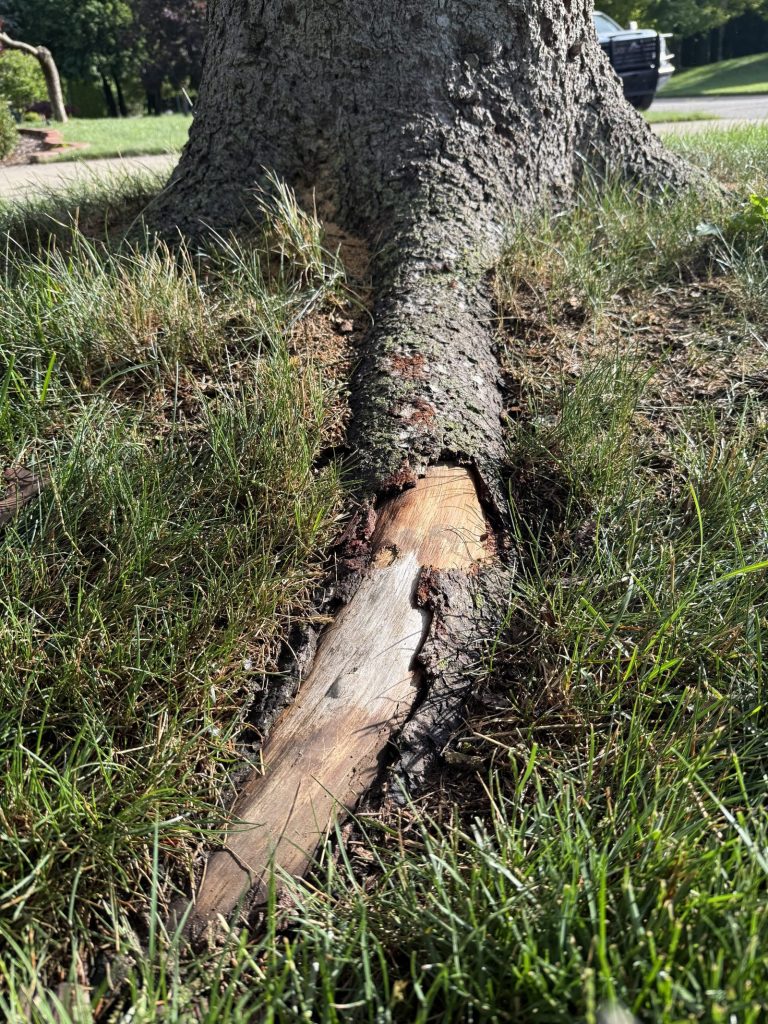
| A crack running down the trunk | Structural failure already in progress | High |
| Soil heaving or cracking opposite a new lean | The root plate is moving. The USDA Forest Service flags soil mounding on the side away from a fresh lean as an especially dangerous sign | Assess promptly |
| A new lean | The roots are letting go. A lean the tree has always had is a different thing | High |
| A cavity or hollow in the trunk | Not automatically fatal, because it depends how much sound wood surrounds it | Assess |
| Two trunks meeting in a tight V | Bark is trapped inside the joint instead of wood, so the trunks were never truly attached. One of the most common places a tree splits in a storm | Assess |
| Dead branches over the driveway, patio or play area | A falling-limb hazard no matter how healthy the rest of the tree is | Prune |
Of everything on that list, shelf fungi at the trunk flare are the sign most often shrugged off. By the time they appear, decay in the structural roots is usually well advanced, and root failure gives no warning at all when it finally happens. They are also seasonal, so no mushrooms today does not mean no decay. Not a verdict on its own, but always a reason to have the tree looked at.
When removal is not the answer
A surprising number of trees that look finished are recoverable.
- A buried trunk flare, the place where the trunk widens into roots. Soil or mulch piled against the trunk slowly girdles the tree over years. Root flare excavation can reverse a decline everyone had written off.
- Girdling roots wrapping the trunk, usually correctable if caught in time.
- Drought stress after a brutal summer. Many trees bounce back with water and a season of patience.
- Storm damage. Losing a big limb looks catastrophic, but crown restoration work saves a lot of these trees.
- A weak fork that can be cabled and braced instead of removed, often for a fraction of the cost.
All of that is pruning and tree health care work, and it is a large share of what we do. When a tree does need to come down, our cost guide explains what the number depends on.
Where we see it most
The mature silver maples and standing dead ash in the older subdivisions of Troy produce most of the tight-V splits and brittle limbs we get called about. The big oaks on the woodland lots around Clarkston hide basal decay under a perfect canopy. And along the lakes in West Bloomfield, leaning shoreline trees with heaving soil on the landward side are the ones we want to see before the next wet spring.
Why a professional opinion is worth the small cost
There is an obvious conflict of interest in asking a company that sells removals whether your tree needs removing.
So protect yourself. Ask whoever assesses your tree whether they are an ISA Certified Arborist, look the name up in ISA’s public directory, and notice whether they ever recommend anything smaller than the biggest job available.
Michigan law adds a practical reason to get it in writing. A property owner generally is not liable when a healthy tree fails in a storm, but can be liable when a known hazard was left standing. A documented assessment protects you either way. Our written tree risk assessment is $399, usually credited toward any work you go ahead with.
Michigan tree law: who pays when a tree falls →When a risk assessment makes sense →
What customers say about our assessments and removals
5.0 stars from 16 Google reviews as of October 2026. Every quote below is copied word for word from our Google listing, where you can read all of them.
- “Rob and his crew did an excellent job. They were polite, professional, and took the time to listen to what I wanted. I appreciated that Rob shared his knowledge and helped me make the right decisions about my trees without ever making me feel pressured.…”
Claire B. · July 2026 · Google review - “Rob did an excellent job removing a couple trees on our property. He was professional, knowledgeable, and very easy to work with throughout the entire process. The work was done safely, efficiently, and the cleanup afterward was spotless. You can tell he takes pride in his work and cares about doing the job right. I would absolutely recommend Rob to anyone looking for a reliable arborist.”
Garret A. · May 2026 · Google review - “Rob and his crew did an amazing job. They were very professional, timely and exercised safety at every step of the process. The cleanup at the end of the job was excellent.”
Ron S. · May 2026 · Google review
Questions we get about dying and dangerous trees
How can I tell if my tree is dead or just dormant?
Use the scratch test. Scrape a thumbnail-sized patch of bark off a twig: green and moist underneath means the twig is alive, brown and dry means that section is dead. Test twigs on several sides of the tree and a couple of larger branches, because trees often die from the top down and a live trunk can be carrying a dead crown. Then check the buds. Dormant trees still carry firm buds through winter; dead wood carries shriveled ones or none. In spring, a tree that is weeks behind its neighbors in leafing out is telling you something. One dead branch low on an old tree is normal shedding, not a verdict. A crown that is thinning from the top, water sprouts erupting from the trunk, and bark sloughing off in sheets together mean the tree is in real decline, and it is worth having it looked at before you decide anything.
Can a tree be dangerous even if it looks healthy?
Yes, and this is the tree that surprises people. Structural failure comes from the roots, the base of the trunk, and the main unions, and none of that is visible in the canopy. A tree can be fully leafed out and green while decay has been spreading in the roots for years. The signs are low and easy to miss: mushrooms or shelf fungi at the trunk flare, a crack running down the trunk, soil heaving or cracking on the side opposite a new lean, and two trunks meeting in a tight V with bark trapped in the joint. Any of those over a house, a driveway, or a play area is worth a phone call. A written risk assessment from a certified arborist costs $399 with us, is usually credited toward any work, and it protects you legally as well as physically, because Michigan treats a known hazard left standing very differently from a healthy tree that fails in a storm.
Should I remove a leaning tree?
Not automatically. Plenty of trees have leaned for decades and are perfectly stable, because they grew that way and built their roots and wood to match. The lean that matters is a new one. If the tree stood straighter last year, if the soil on the far side of the lean is heaving, cracking, or mounding, or if roots are lifting out of the ground, the root plate is moving and the tree can go over in the next wet, windy spell. That is a call-today situation. An old, unchanged lean over open lawn is usually nothing. An old lean over the house is worth a look, because the target matters as much as the tree. We assess, photograph, and give you a written answer, and we will say so if it does not need to come down.
What does a tree risk assessment cost?
$399 for a written assessment with photos, usually credited toward any work you go ahead with. If you just want a quick opinion, a free on-site estimate covers that.
Pruning and tree health care →Emerald ash borer in Michigan →Oak wilt in Michigan →Storm damage and emergencies →All tree care guides →
Not sure what you are looking at?
Text us a photo, or book a free on-site assessment. If it does not need removing, that is exactly what we will tell you.