Why Topping a Tree Does More Harm Than Good in Oakland County
Updated September 2026 · Written by Rob Burgund, ISA Certified Arborist MI-4857A
- ISA Certified Arborist MI-4857A
- Working in Oakland County since 2013
- Licensed and insured
- 5.0 stars from 15 Google reviews
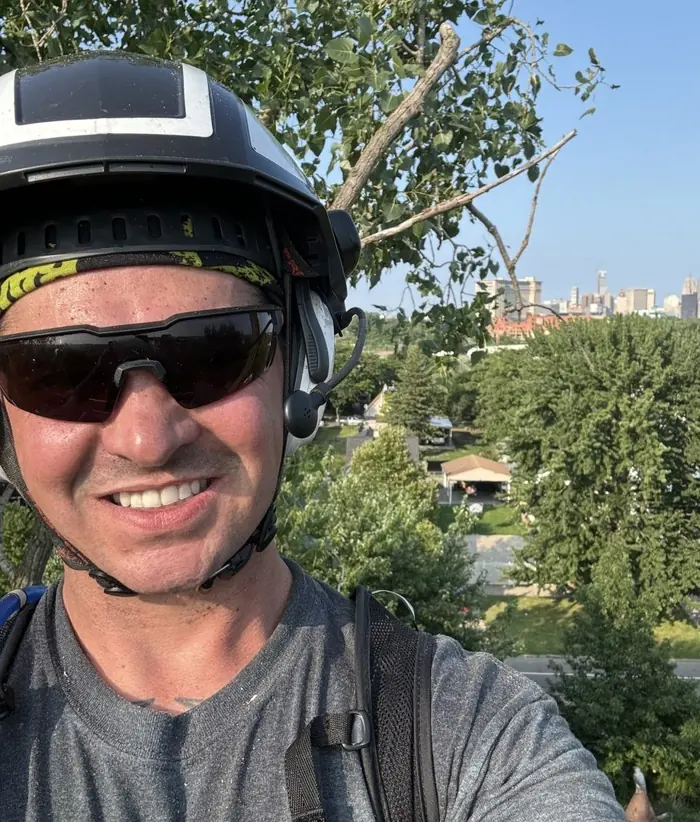
Written by Rob Burgund
ISA Certified Arborist · MI-4857A
Rob owns Tree Pros, LLC in Bloomfield Township and is the arborist who quotes and works every job. He has been doing tree work in Oakland County since 2013. More about Rob and Tree Pros, or verify the certification in ISA’s public directory.
What topping actually is
Topping means cutting main scaffold branches, or the central leader, back to stubs or to a lateral branch too small to take over as the new leader. It is different from crown reduction, which cuts back to a lateral branch large enough to assume the role of the limb removed. The distinction matters more than it sounds like it should, because it is the difference between a cut a tree can heal from and one it cannot.
The hidden hazards of a topped tree
- A topped tree loses a large share of its canopy at once, cutting off most of its ability to produce the energy it needs to recover and defend itself.
- The exposed stubs do not seal properly the way a correct cut at a branch collar does, which leaves an open door for decay fungi and insects for years afterward.
- Losing that much leaf area triggers a stress response: the tree pushes out dozens of fast-growing, weakly attached shoots called water sprouts, trying to rebuild the canopy it lost.
- Those water sprouts are far more likely to break off in wind than the original limbs were, which is the opposite of what topping was supposed to accomplish.
- A topped tree typically declines over the following years, developing dead wood and structural weakness at exactly the cuts that were supposed to make it safer.
What the pruning standard actually says
Topping is not simply discouraged, it is against the accepted pruning standard for the industry. The International Society of Arboriculture publishes consumer guidance stating plainly that topping is not a viable method of height reduction and increases risk rather than reducing it. Correct pruning cuts are made just beyond the branch collar, where a healthy tree is biologically equipped to close the wound. A cut made mid-limb, between laterals, leaves a stub the tree often cannot close over, and the exposed wood decays instead. If a limb genuinely needs to come back, ISA’s own guidance is clear. Cut to a lateral branch at least one-third the diameter of the limb being removed, never to a bare stub. A company offering to top a tree is offering a cut the industry’s own consumer guidance describes as one of the most harmful pruning practices there is.
What to ask for instead
- Crown thinning. Selectively removes branches from inside the canopy to reduce wind resistance and weight, without changing the tree’s natural outline.
- Crown reduction. Cuts back to a lateral branch at least one-third the diameter of the limb being removed, lowering the tree’s height or spread while keeping its structure sound.
- Deadwood removal. Takes out only dead or diseased limbs, which improves both safety and appearance without touching healthy wood.
All three do the actual job a homeowner usually wants from topping, a smaller, safer-looking tree, without the decay-and-regrowth cycle that topping starts. They also tend to hold up better in Oakland County’s heavy spring rain, winter ice and summer wind than a topped tree does. That is because the tree keeps a structurally sound branch framework, instead of a crown of weakly attached regrowth.
What we see on topped trees in Oakland County
Previously topped trees are a routine callout for us across Waterford, Birmingham and the rest of the county. Usually the regrowth has become hazardous, or the trunk has started to show decay at the old cut points. In most cases the homeowner paid once for the topping and is now paying again, either for corrective pruning or for a removal that proper pruning years earlier would have avoided. Did a tree on your property get topped in the past? If it now looks thick with fast, upright growth at the old cut sites, that is worth having assessed rather than left to keep going.
Pruning and crown reduction →Tree removal, if it has already gone too far →Signs a tree is declining →
Frequently asked questions
Is topping ever the right call for a tree near power lines?
Utility line clearance pruning looks similar from the ground but follows a different standard aimed specifically at keeping wood away from the conductor, done by utility-trained crews. For a tree on your own property that is simply too tall or too close to your house, crown reduction accomplishes the same size reduction without the stub cuts that make topping damaging.
My tree was already topped years ago. Can it be fixed?
Not undone, but it can often be corrected going forward. An arborist can selectively thin the water sprouts that grew back after topping, choosing the best-attached ones to develop into a new, sounder structure and removing the rest. It takes a few pruning cycles over several years rather than one visit, and it will not fully restore the tree’s original form, but it meaningfully reduces the failure risk the topping created.
Why do some companies still offer topping if it is against the standard?
It is fast and it is cheap compared with a proper reduction, and it gives an immediately visible result a homeowner can see the same day. The cost shows up later, in storm-damaged regrowth or decay, which is usually a different visit and sometimes a different company. Ask any company quoting size reduction whether they are proposing a reduction cut to a lateral branch or a stub cut, and ask for their ISA certification number.
How much does crown reduction cost compared to topping?
Proper reduction pruning on a mature shade tree in Oakland County typically runs $400 to $900, in the same range as other pruning work. It is priced on time and access, not on how the cuts are made. Topping is sometimes quoted cheaper because it takes less skill and less time per cut, which is part of why it persists despite the standard against it.
Will a topped tree eventually die?
Not always, but its life expectancy and structural reliability both drop. Some trees survive topping for decades, slowly declining and regrowing weak wood the whole time. Others fail structurally within a few years once decay reaches the trunk through the old stub cuts. Because that outcome cannot be predicted reliably in advance, the safer approach is not to top the tree in the first place.
Considering size reduction on a mature tree?
We will tell you honestly whether crown reduction, thinning or removal is the right call, and we do not top trees. Free on-site estimates across Oakland County.